- Volleyball
Volleyball Court Dimensions and Flooring Requirements
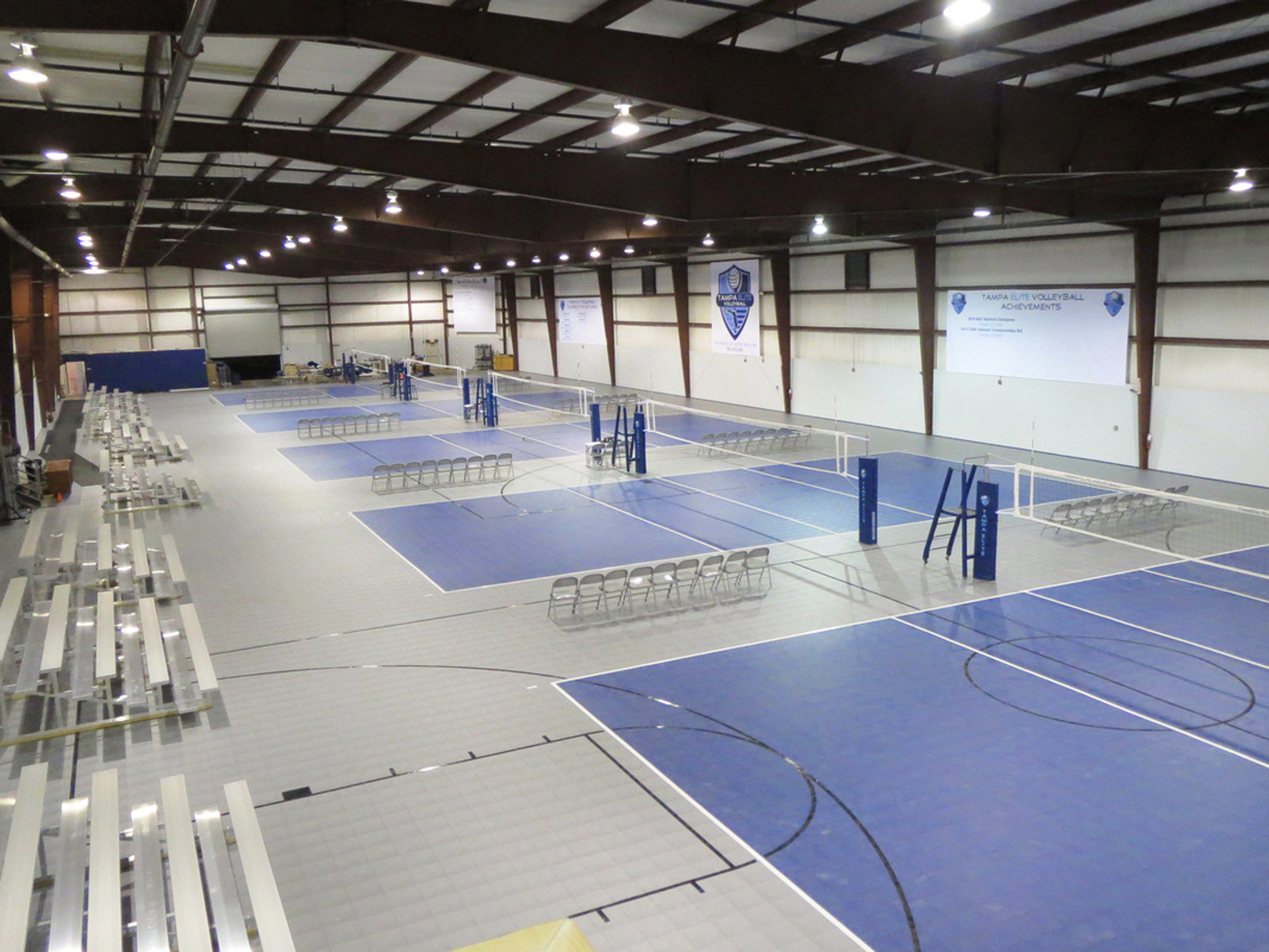
(All Dimensions and Rules Based on Current Rulebooks as of 9/12/26)
Planning your indoor volleyball court flooring layout and floorplan will ultimately depend on a few factors that will be specific to your courts and the games that will be played in your space. The first step in creating your layout will be to consider a few simple questions:
- What type of games will be played on my court? Will they need to follow NCAA rules, NFHS (High School rules), international dimensions, or will this be a recreational facility used for fun and practice?
- How much space do I have, and how much space will an indoor volleyball court require?
- How many volleyball courts will I need to fit in my facility?
- What will an indoor volleyball court cost?
Knowing the answers to these few questions can help to guide your court layouts and make planning your space a breeze.
What Are the Dimensions for an Indoor Volleyball Court?
In the world of indoor volleyball, there are three primary governing bodies that will dictate the legal size and dimensions of courts that are to be used for sanctioned play. These three authorities are the NCAA (National Collegiate Athletic Association), NFHS (National Federation of State High School Associations), and the FIVB (Federation of International Volleyball).
Each individual organization will have slightly different specs and requirements for legal court spaces. Unfortunately, not every court size will be technically legal for all three governing bodies, so the first step will be to assess your space and decide which set of game lines you will need to apply and follow for your primary players. If you are hosting college level matches, the NCAA rules will be the best to follow. For US High School sanctioned matches, the NFHS court dimensions will work best for your space. If you will need to host internationally sanctioned games, the FIVB court dimensions are your best bet. The primary differences between these court sizes are due to the use of metric measurements internationally and in NCAA play, and the preference for standard English measurements/Imperial system measurements in the NFHS rulebook. This will slightly change the math on calculating the total length and width of an individual court, but it is important to follow the rulebook as closely as possible when planning your space to ensure your players will be used to a standard court size and that your court will be considered a legal hosting site.
NFHS Volleyball Court Dimensions and Flooring Requirements
As previously mentioned, NFHS courts are based on the Imperial measuring system which is commonly used and followed across the United States, all measurements will be done in units of feet and inches. The total in-bounds court area will measure 60' long and 30' wide, with all lines measuring 2" in thickness. Because a ball that is hit and touches a perimeter line is considered "in-bounds", it is important to include your 2" game lines within the 60' x 30' dimensions, marking an area of 59' 10" x 29' 10" between the interior point of each perimeter line. The court "Center line" will also be a 2" game line that will straddle a singular string line during the painting process, leaving 1" on either side. Attack lines will then measure 10' out from the measured center string line of the court. 6" service lines will be established at the corners of each court, 8" away from the end line.
Beyond these painted or taped court game lines, there is a a requirement to leave a minimum clearance space of 6' completely surrounding the court for safety purposes. With the minimum clearance space applied, the total size of your court footprint will need to legally measure at least 72' x 42'. Link to the NFHS Volleyball rules and regulations page can be seen here.
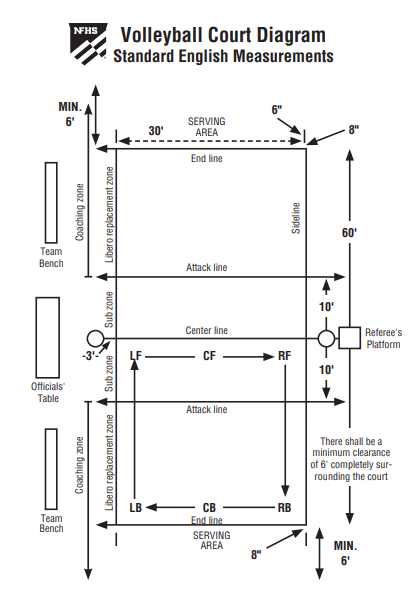
NFHS Volleyball Court Diagram via NFHS.org
NCAA Volleyball Court Dimensions and Flooring Requirements (Womens)
NCAA court regulations are naturally different than NFHS regulations, primarily due to the different units of measurement. NCAA court regulations, specifically Womens as Mens regulations will ultimately follow the FIVB court dimensions to be described later, call for measurements to be done in metric units like meters and centimeters (all game lines will measure 5 centimeters, or approximately 2 inches, in width).
Womens NCAA volleyball court dimensions will measure 18 meters long (59 feet) by 9 meters wide (29 feet, 6 inches), with in-bounds Attack lines extending 3 meters (9 feet, 10 inches) from the center stringline, and service dashes measuring .15 meters in length at a .2 meter distance from the 4 corners of the court. Extended attack lines will measure 15 centimeters in length, and will contain 5 dashes that are 20 centimeters apart beyond the perimeter side lines to a max length of 1.75 meters (5 feet, 9 inches) and will act, literally, as extensions of the attack lines.
In regards to the free zone beyond the in-bounds court space, the recommended free zone area is 3 meters (9 feet, 10 inches) outside of each sideline and 4.5 meters (14 feet, 9 inches) beyond each end line, and this will be mandatory for all new facilities that were constructed after 106.
To review additional details and specs, please reference the Womens NCAA Volleyball Rulebook here.
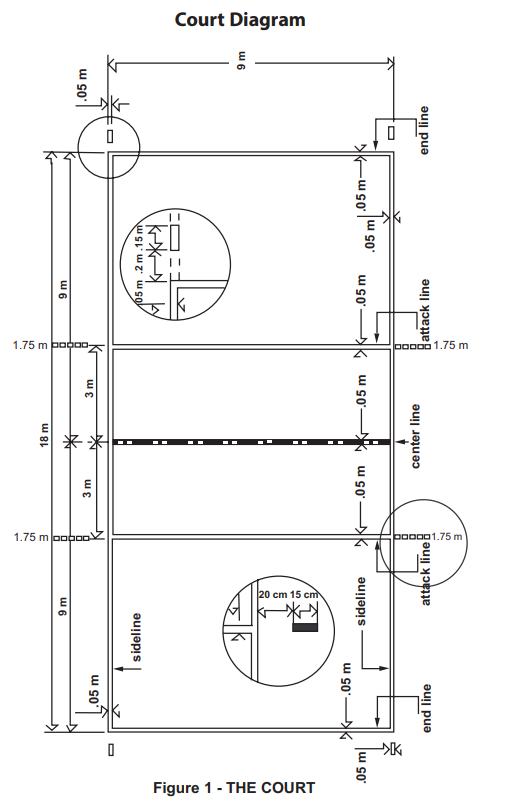
Womens NCAA Volleyball Court Dimensions via NCAA.org
FIVB (International) and Mens NCAA Volleyball Court Dimensions
Both Mens NCAA and Internationally sanctioned volleyball matches will follow a similar size and layout to the Womens NCAA court dimensions, being an in-bounds area of 18 meters by 9 meters with 5 centimeter wide lines as well. The differences between the international/Mens and Womens Court dimensions can be found in the free zone requirements, which will differ depending on the rules your sanctioned match will fall under. The table below will outline free zone requirements for each set of court dimensions:
| NFHS | NCAA (Womens) | NCAA (Mens) | FIVB | USAV (USA Volleyball Rules) | |
|
Court Dimensions (In-Bounds) |
60' x 30' | 18m x 9m (59' x 29' 6") | 18m x 9m (59' x 29' 6") | 18m x 9m (59' x 29' 6") | 18m x 9m (59' x 29' 6") |
| Free Zone Minimums | 6' around perimeter | Facilities built before 2016 - 2m around perimeter Facilities built after 2016 - 3m on sidelines, 4.5m beyond endlines |
Minimum of 2m around perimeter |
FIVB, World and Official Competitions: 5m on each sideline, 6.5m on each endline, otherwise 3m minimum around perimeter |
2m around perimeter |
| Total Court Footprint | 72' x 42' | 27m x 15m for new facilities | Minimum of 22m x 13m |
FIVB, World and Official Competitions: 31m x 19m |
Minimum of 22m x 13m |
What Is an Approved Surface for Indoor Volleyball Court Use?
While there are some disparities between these court dimensions, each of these governing bodies agree that the surface must be of a wood or synthetic court material. ProGym or ProGym Plank by Mateflex are two options that will meet this criteria and have been used for volleyball courts in all levels of play for 15+ years. The ProGym tile specifically is an excellent option for indoor volleyball court flooring in facilities like churches, high school to collegiate level courts, and every level in between.
The ProGym tile is an excellent indoor volleyball court option due to its customizability, allowing court owners to custom design their courts to best fit their facility, as well as overall durability, longevity, minimal maintenance costs and comfortability as well. The ProGym tiles feature rounded edges and corners with player safety and comfort in mind, this will help to greatly minimize the risk of snagging a jersey or skin on the corner or seam of a tile when sliding or diving. This will allow for players to feel safe and to play with minimal inhibition, creating a better overall level of play.
Need a quote or cost estimate for a new indoor volleyball court? Look no further than Mateflex and contact us today for a free consultation!