- Volleyball
Indoor Volleyball Court Surface Comparison - Which Product Will Work Best For You?
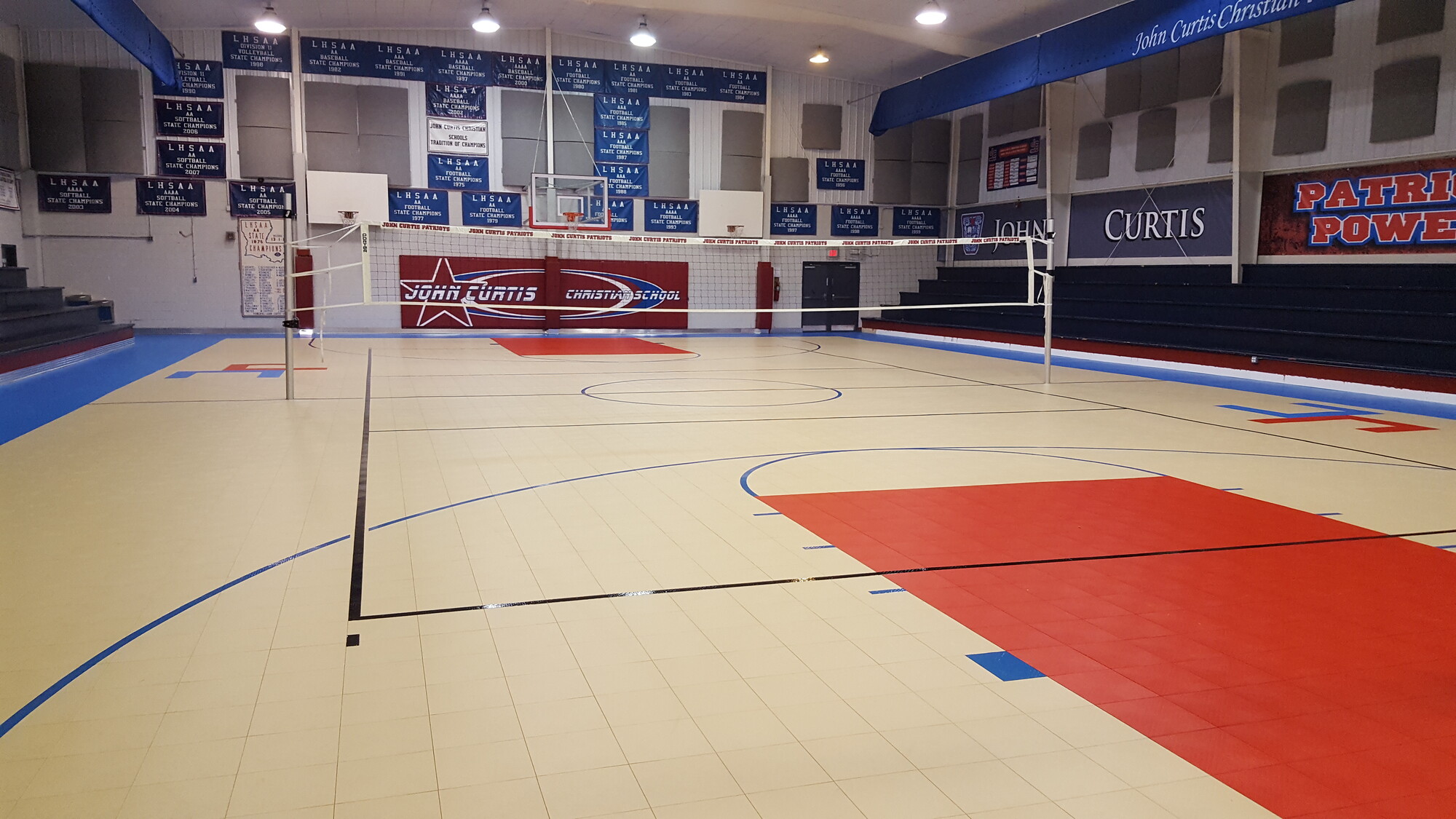
Whether you are designing a high school athletic facility, upgrading a community recreation center, or building a dedicated training academy, choosing the right volleyball court flooring is one of the most critical facility decisions you will make. Both Men's and Women's Volleyball are explosive, high-impact games that ideally have a surface designed to cater to their specific athletes. Over the course of a single match, athletes execute hundreds of maximum-effort vertical jumps and lateral movements that need to be accounted for to prevent injuries and promote high-quality play.
For volleyball specifically, the floor underneath the players directly affects player safety, athletic responsiveness, and your facility’s long-term operating budget. While traditional maple hardwood and rolled vinyl have long dominated gymnasium floors, and for good reason, modern athletic directors and facility managers are increasingly turning to alternate solutions to help absorb cost, maximize their facilities versatility and effectiveness, and to cater to specific athletes and customers alike.
Below is an in-depth volleyball court surface comparison of the top indoor options that Volleyball facility managers may consider for their space:
What Are The Most Popular Indoor Volleyball Court Surface Options Available?
There are a variety of popular indoor volleyball court flooring options for school, club and recreational use. Some of the more popular volleyball court surface options are:
- Maple Hardwood Gym Flooring
- Point-Elastic Sheet Vinyl / PVC Flooring
- Poured-in-Place Polyurethane (PU)
- Modular Athletic Court Tiles (ex: Mateflex ProGym or ProGym Plank)
The best choice for your club out of these four options will ultimately depend on several factors including cost and your facilities overall budget, your aesthetic preferences (colorful court vs. hardwood look), and what other activities may also take place in this location. Below is a breakdown of each option that takes a closer look at product specifications and the pro's and con's of each material type:
Solid Maple Hardwood Volleyball Court Flooring
For years, sprung northern hard maple has been the historic benchmark for collegiate arenas and professional venues. While the look of a traditional hardwood court is often unmatched, the high cost both initially and for annual maintenance can cause some to look in another direction.
Pros:
-
Traditional Prestige: Delivers the classic aesthetic, rich wood grain, and iconic squeak associated with elite arena competition.
-
Consistent Ball Rebound: Paired with an engineered subfloor sleeper system, high-quality hardwood provides predictable, uniform ball rebound and firm footing. This is especially important for facilities that share time with basketball and other high-performance athletic applications.
Cons:
-
Highest Lifecycle Costs: Hardwood carries the highest upfront material and installation price in the industry. Beyond installation, it requires mandatory annual screen-and-recoats ($1,500–$3,500/year) and full mechanical sanding, repainting, and resealing every 8 to 10 years ($10,000+).
-
Vulnerability to Moisture & Climate: Hardwood can be severely affected by moisture; unconditioned air, localized humidity shifts, or minor slab moisture will cause boards to cup, crown, or buckle, resulting in expensive structural repairs.
-
Downtime: When refinishing a wood court, the entire facility must be shut down for 7 to 14 days due to curing times and VOC off-gassing. These breaks can add up over time.
Point-Elastic Sheet Vinyl / PVC Athletics Flooring
Often seen in dedicated international volleyball venues, rolled PVC/vinyl flooring consists of a textured wear layer bonded over a closed-cell foam backing.
Pros:
-
High Point Elasticity: The foam backing yields soft, forgiving landings directly under the athlete’s foot.
-
Vibrant Visuals: Available in custom court colors and simulated wood grains with clean, crisp game line integration.
Cons:
-
Permanent Adhesive Vulnerability: Sheet vinyl relies on full-spread adhesives. If ground moisture vapor rises through the concrete substrate (hydrostatic pressure), the adhesive fails, creating massive, unsightly bubbles across the court that cannot be easily flattened.
-
Susceptible to Gouging and Indentations: Heavy rolling loads—such as portable bleachers, scissor lifts, and equipment carts—can permanently crush the foam backing or tear the vinyl wear layer.
-
Difficult Sectional Repairs: Torn or damaged sheet vinyl requires heat-welded patch seams that leave visible scars requiring professional assistance.
Poured-in-Place Polyurethane (PU)
Poured polyurethane combines a rubber crumb base mat with a liquid polyurethane seal and topcoat, yielding a seamless, rubberized floor.
Pros:
-
Seamless Surface: Completely eliminates seams, grout lines, or panel joints across the entire court perimeter.
-
Good Tensile Durability: Highly resistant to mechanical puncture from standard indoor athletics use.
Cons:
-
Costly & Chemical-Heavy Installation: Installing poured PU requires multi-day hand troweling, specialized commercial ventilation, and strict atmospheric controls. Curing times can disable your gym for up to a full week.
-
Difficult Resurfacing: When the top wear layer dulls or loses its slip-resistance, applying a new wear coat requires specialized contractors and considerable cost.
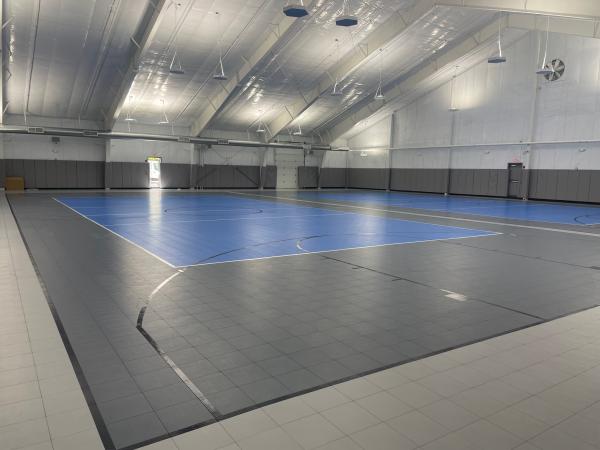
ProGym By Mateflex Is the Ultimate Court Tile Surface for Multiple Applications
Modular Volleyball Court Tile: Mateflex ProGym
Engineered specifically for demanding multi-use environments, Mateflex ProGym is a solid-top, high-impact polypropylene modular tile designed to deliver the high-end playability of hardwood without the grueling maintenance cycles.
The Mechanics:
-
Dimensions & Construction: 12″ x 12″ x 1/2″ solid-top tiles
-
Locking Mechanism: 5 positive interlocks per side for a unified, free-floating court.
-
Load Rating: Static load capacity of 18,000 lbs. per square foot (125 psi).
-
Surface Profile: Smooth, flat top with micro-beveled edges designed to eliminate snagging during dives and slides.
Pros:
-
Unmatched Athlete Protection: Unlike rigid floors, ProGym and the recommended 3mm rubber underlayment provide excellent shock absorption for intense matches.
-
Dive-Friendly & Non-Abrasive: The solid, smooth surface and rounded corners allows players to perform without worry of snagging a jersey or skin on sharp tile edges.
-
Minimal Down-Time Installation: ProGym installs as a free-floating system directly over existing concrete, worn synthetic floors, or aged hardwood without messy glues, toxic fumes, or extensive subfloor prep. With a pre-painted volleyball court, your players can immediately use these materials right out of the box from the manufacturer with no wait or cure time.
-
Bulletproof Durability & Moisture Resistance: ProGym is not affected by moisture, so ground moisture or high humidity is not a cause for damages to these materials. If a concrete slab sweats or an overhead pipe leaks, the tiles will remain undamaged.
-
Low Maintenance, High ROI: ProGym never requires sanding, stripping, or polyurethane recoating. Routine care is as simple as a dry dust mop and occasional damp mopping, with game line paint repairs occurring every few seasons as-needed, if needed at all.
-
Targeted Repairability: If a tile is somehow damaged, you simply pop out that individual 12" x 12" piece and click a replacement in within seconds—no costly specialized repair crews required.
- Removable If Necessary: ProGym tiles are floating and can be re-packaged and moved to a new location should you be using this volleyball court surface for a temporary lease or seasonal facility.
Cons:
-
Acoustic Profile: As a floating modular floor, it produces a slightly different sound profile upon ball bounce compared to nailed-down solid hardwood (though acoustic underlayment rubber dampens this substantially).
-
Initial Surface Feel: Athletes accustomed exclusively to polished maple may require a brief warmup session to adapt to the smoother texture.
Head-to-Head Comparison: Finding Your Ideal Fit
| Mateflex ProGym | Maple Hardwood | Point-Elastic Vinyl | Poured Polyurethane | |
| Material Type | High-Impact Polypropylene | Solid Northern Maple | PVC w/ Foam Cushion | Rubber Mat + Liquid PU |
| Installation Method | Interlocking Floating Tile | Nailed Sleeper System | Full-Spread Adhesive | Liquid Poured/Troweled |
| Impact Absorption | Built-in Flex / Suspended Ribs | Moderate to High (System dependent) | High (Foam Point-Elastic) | High |
| Moisture Resistance | Not Affected By Moisture/ Self-Venting | High Risk (Warps/Buckles) | High Risk (Adhesive Blistering) | Moderate |
| Annual Refinishing | None Required | Mandatory Annual Recoating | None | Periodic Retopping |
| Single-Tile Repair | Yes (Under 2 Minutes) | No (Extensive Carpentry) | No (Welded Patching) | No (Cut & Pour) |
| Multi-Use Versatility | Exceptional (Basketball, Inline Hockey, School Gym Classes) | High (Gym/Basketball) | Moderate (Prone to load dents) | High |
Elevate Your Facility with Mateflex
When evaluating volleyball court flooring, the ideal solution balances player welfare with financial common sense. While hardwood and rolled synthetics carry heavy maintenance schedules, high risks of water damage, and costly downtime, modular volleyball court tile gives athletic directors complete peace of mind.
Mateflex ProGym delivers a professional-grade indoor volleyball court surface that handles aggressive tournament play, saves your athletes' joints, withstands daily multi-application activity, and installs cleanly in a fraction of the time. If a modular athletic tile with a traditional hardwood surface look is required, our ProGym Plank is available as well, please contact a Mateflex representative to discuss the differences between these materials and to find out which product is right for you.
Ready to transform your gym or facility? Reach out to the court design specialists at Mateflex to receive custom court layout designs, color renderings, and a comprehensive project estimate.
Mateflex Volleyball Court Tile FAQ's
Not exactly. NFHS high school courts measure 60 feet by 30 feet, while NCAA courts measure 18 meters by 9 meters, or approximately 59 feet by 29 feet 6 inches. Free zone and court marking requirements can also differ.
Yes. Matéflex modular flooring can accommodate multiple game styles on a single playing surface. Depending on the available space, you can incorporate basketball, pickleball, tennis, or other recreational court markings into your layout.
Yes! Mateflex modular court tiles are portable, and are the perfect option to utilize as a seasonal or temporary volleyball court. If your plan is to place these tiles over a surface that you would like to protect, you can use a rolled underlayment to add cushion, reduce noise, and act as a buffer between your tiles and your hardwood or VCT court surface.
A new maple hardwood gym floor is a major investment, often ranging from $15 to $25+ per square foot installed, depending on the subfloor system and geographic location.
The total amount of space depends on the governing body because a free zone must be included around the in-bounds playing area. For example, an NFHS court requires a minimum overall footprint of 72 feet by 42 feet when the required clearance is included.
Typically, a hardwood gym floor requires a full sanding and refinishing every 5 to 10 years, depending on the level of use and the quality of daily maintenance.
One of the main advantages of using a modular tile system is the ability to easily remove and replace tiles in the center of your court. This ability is valuable for court owners, should they need to replace a damaged tile or access the subsurface underneath their flooring. To remove a tile, we would recommend using a wide, thin tool (such as a standard 5-in-1 tool or putty knife) to gently wedge between the seams of your tiles, using the edge of the tile as a lever to pop up the locks underneath. Once you have disengaged a large enough section of tile locks, you should be able to remove the rest of the tile by hand. See how we would remove a tile in our video below:
NFHS indoor volleyball courts measure 60 feet long by 30 feet wide. NCAA, FIVB, and USA Volleyball courts generally measure 18 meters by 9 meters, or approximately 59 feet by 29 feet 6 inches.
Need a quote or cost estimate for a new indoor volleyball court? Look no further than Mateflex and contact us today for a free consultation!