- Basketball
Backyard Basketball Court Cost Guide
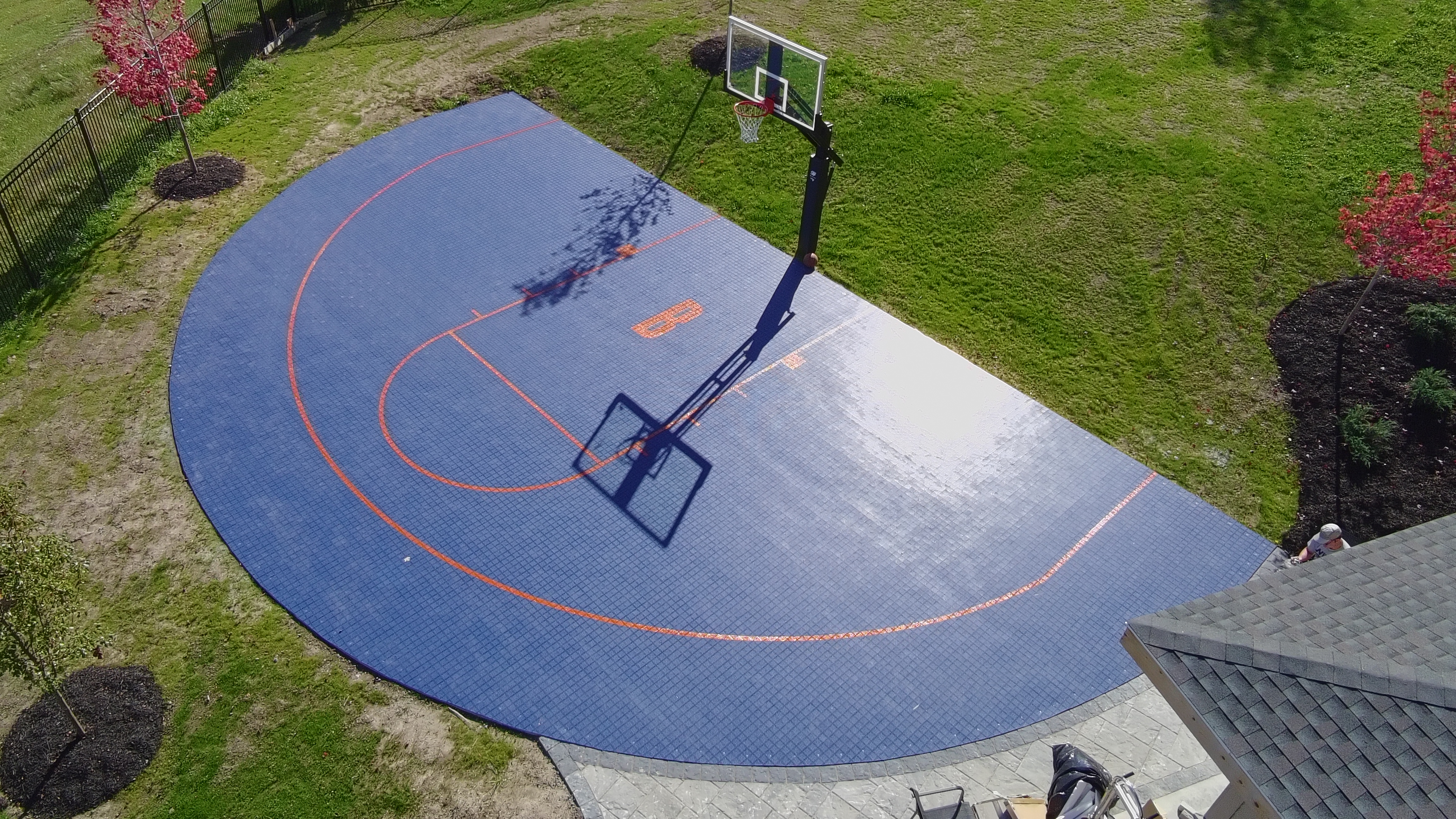
How Much Does a Backyard Basketball Court Cost?
Planning a dream backyard basketball court is almost inevitable for any homeowner that's a fan of the game, but before you pick out your court colors or design the perfect logo to use at center court, the first question that comes to mind is naturally: What does a backyard basketball court cost? While pricing out a premium backyard home basketball court can feel overwhelming due to all of the moving parts, breaking the process down into clear, manageable steps makes budgeting simple.
The total investment for a high-performance outdoor basketball court surface relies on several major factors and will definitely vary depending on your location and needs, but there are a few key starting points when it comes to the planning process: how large of a court you are looking to build, the prep work to clear the space on your property, the base work to lay your foundation of choice (like concrete, asphalt or compacted stone), and finally, your choice of high-quality backyard basketball court flooring, such as a premium Mateflex HomeCourt tile system. Whether you are aiming to build a modest DIY shooting key or a professional size full court, this guide will break down the required materials, site preparation, material and installation considerations that are to be made so you can confidently design a basketball court that fits both your athletic goals and your family budget.
What is The First Step to Building an Outdoor Basketball Court in my Backyard?
When it comes to the very first steps of planning for your backyard basketball court installation, we would recommend starting with measuring and deciding how much space you would like to dedicate to this endeavor. Anyone that is in the market for a home will understand that there are certainly the "have's" and the "have-not's" when it comes to available space. Because our tiles are sold by the square foot, we can customize your court to fit whatever size will work best for you.
A few common sizes that homeowners may consider for a backyard court can be seen below:
The Backyard Shooting Pad
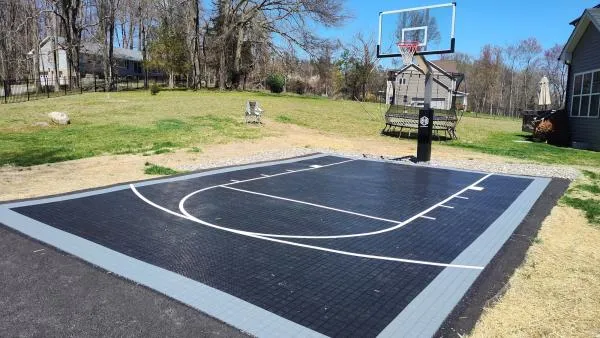
The "Shooting Pad"
- These courts are typically large enough to accommodate a regulation 15' distance from the face of the backboard to the free throw line, but often too tight to fit a full 3 point arc.
- Any size between roughly ~25' x 25' to 35' x 35' will be big enough for backyard 1 vs. 1 tournaments, to practice layups and free throws, or to just have a place to shoot around with the kids.
- These court sizes are a great option for large driveway conversions to a court space or for homeowners who have minimal space to dedicate to a court.
- These courts are great for those on a budget as well, they are the perfect DIY backyard basketball court option for those who are looking to save on installation costs. Mateflex can pre-paint and customize your game lines to best fit a smaller court surface like this, plenty of our customers have included an abridged 3 point arc or simply scrapped that line altogether for an even simpler look.
The "Half Court"
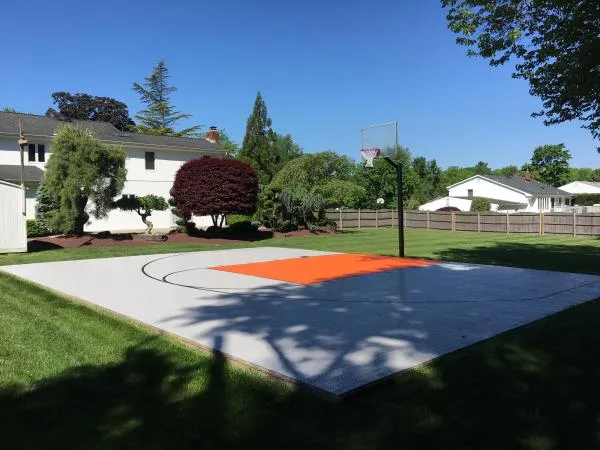 A modified "Half-Court"
- When we are discussing a "backyard half court" with our clients, we are typically referencing a court that contains a single hoop with a full free throw lane, and is wide enough to accommodate a full size three point arc as well.
- The regulation width of a basketball court is 50' inside the out of bounds lines, so anywhere from a 50' width and up will allow for the true "half court" experience, even if the length is not exactly at the midcourt line.
- With "half courts", we also have seen a huge interest in including additional game lines like Pickleball. A standard sized pickleball court will measure 60' x 30' in total, so by placing a backboard at the center of the 60' side you can easily accommodate a full three point arc, a regulation basketball court lane and free throw line, and still prioritize pickleball play. A 60' x 30' court is a fantastic stock size to consider for a multi-court surface in your backyard.
The "Full Court" and Beyond
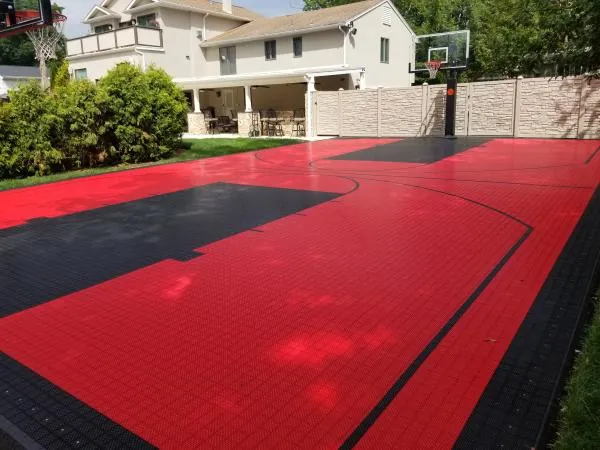 A "Full Court" With Two Basketball Hoops at Either End
- Much like the vague sizing of what most would call a "half court" in most cases, the "full court" experience really comes down to being able to utilize two hoops on either end of the court with full three point arcs included on either end of your layout.
- The sizing for these courts can vary, as we have made courts with two three point arcs that are only ~50' long with minimal space in between arcs, but to fully incorporate a "full court" you will need to start at an in-bounds measurement of 84' long and 50' wide, with additional out of bounds space to be considered so your players are not stepping directly off the tiles if they step over the perimeter line.
- The 84' x 50' size will fit a regulation High School basketball court, but note that NBA and NCAA lines are actually 94' x 50' with adjusted three point arc sizes as well.
- A court that is this size can be a bit much for the majority of homeowners, but the added benefit of such a large space is that you can now include not only Pickleball very easily into your layout, you can also consider Tennis game lines, Volleyball and Inline Hockey as well.
- With a standard sized tennis court measuring 120' x 60', we also see many homeowners converting an existing tennis court into a large multi-court space that can be used for a wide variety of games and activities. Obviously the much larger inline hockey rink conversion will work as well in the same way, these are typically 180' x 80' - 200' x 85' in size, so there is plenty of space to work with!
What is the Best Base Material To Use for my Backyard Basketball Court?
After you have agreed upon a size for your new court space, the next step in the building process will be to lay a foundation material that will provide a solid, durable foundation for years to come. Mateflex tiles will need to lay over a base of either concrete, asphalt, or a pervious base option like compacted stone, and any of these options can work just as well as the others. There is no preference from our end as long as the base remains hard, flat and compact over time to provide a safe surface with a consistent ball bounce over the 15+ years that your court will be used for. The ball bounce is directly affected by the base materials underneath our tiles, so it is highly recommended to make sure your base is a quality build to ensure best results.
Sourcing the best option here will require some initial research by the homeowner, as the material costs can vary based on your location, and some areas may have specific regulations that will truly guide your selection. In some cities, asphalt is a more viable option than concrete and vice versa, and this may be the result of material costs or limitations due to weather and climate. A permeable base may be the only option forward as well if your area has a limit on impervious surfaces due to flooding/drainage requirements, etc. Because there is no blanket answer that can be provided for this, it will be best to contact a local contractor with our base specs and information handy to discuss your best and most affordable path forward.
What is the Best Outdoor Basketball Court Surface?
The best material to use for your backyard court will ultimately depend on your budget and your aesthetic preference. A modular outdoor tile system is an excellent budget friendly option that can be installed by the average homeowner, it is a fantastic do it yourself backyard basketball court flooring project that will help to keep expenses to a minimum.
Our HomeCourt tile is the perfect basketball court tile option that provides a very solid ball bounce, is extremely durable and customizable for your space, and is comfortable for all types of applications. Our TopCourt tile is a great option as well if you are interested in using this space for pickleball, or if the area tends to stay moist after a rainfall, the TopCourt provides excellent drainage and very fast dry times so you can quickly return to play.
In addition to mixing and matching our 21 stock colors to create the layout of your choice, we can also paint custom game lines and logos to truly make this court your own! You can expect Mateflex outdoor tiles to last 20+ years with minimal maintenance outside of keeping the surface clear of debris.
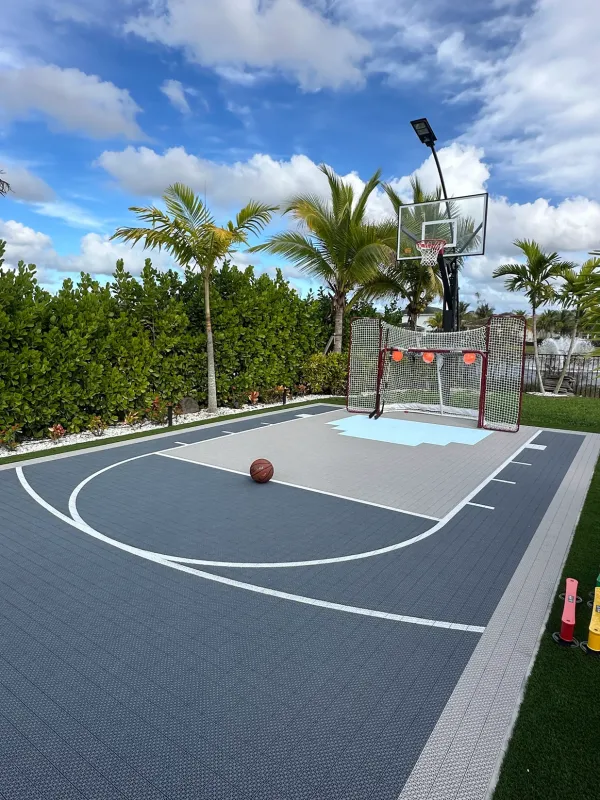
A backyard basketball court with a light system and hockey net
What Basketball Court Accessories Should I Add to My Backyard Court?
After you have sourced the base materials and your court surface of choice, you are almost at your goal of hosting a backyard tournament or clinic, but don't forget your hoop! There are a wide variety of accessories to choose from depending on your budget and how you plan to use your court.
- Basketball Hoop: There are a wide variety of hoop systems to choose from, and ultimately this is best narrowed down by being honest about your budget and what you are willing to spend, as these can definitely become very pricey for the average buyer. If you are looking to spend between $150 - $1,000 and do not need anything for serious competition, a portable unit can be easily sourced from your nearest sporting goods store.
- Adjustable In-Ground Hoop: If you have a larger budget and are interested in installing an adjustable in-ground unit with a tempered glass backboard, there are several tiers of hoop system that you can shop for, and a Mateflex representative would be happy to help guide you through this process.
- Multi-Sport Net System: You can also consider adding an in-line or a standalone net system to combine your basketball court with other games like pickleball, tennis or volleyball. Some of these are adjustable so you can use them for all types of applications.
- Hockey Net: Lastly, a hockey net is a great addition to this space. These are usually around $150 - $500 in price to start depending on the quality you are interested in proceeding with.
Conclusion
While it is close to impossible to provide a single answer that will be an accurate representation of the overall cost of a basketball court, this guide should be a solid starting point with your research.
If you will need to figure out the last piece of the puzzle and receive an estimate for our pre-painted basketball court tiles, please do not hesitate in giving our sales team a shout! Contact us today for a free estimate and consultation in planning your court from scratch!
Courtside Questions
Yes! Many customers choose to do these projects on their own. If you already have a concrete or asphalt pad in place and are looking to spruce it up by overlaying our tile system, DIY is the way to go. Or, you can hire your trusted local contractor to build the base for the court and install the tiles to keep your costs down.
In NCAA college basketball, each half is 20 minutes of playing time, for a total of 40 minutes per game (compared to the NBA's four 12-minute quarters). When planning gymnasium flooring or multi-purpose court surfaces for college-level play, Matéflex ProGym and ProGym Plank are engineered to handle constant play.
There are several sizes to consider when planning to construct an indoor or outdoor basketball court. Professional and other high-talent leagues such as the NBA and NCAA will use an in-bounds area of 94’ x 50’ for their basketball court dimensions, and international leagues such as FIBA will specify a very similar size of 28 meters (92’ ft.) by 15 meters (49’ ft.). High School basketball court regulations call for an 84’ x 50’ in-bounds area, and younger leagues can have an even smaller court dimensions, most commonly a size of approximately 74’ x 42’.
Note that for safety purposes, it is highly recommended to add an additional 3’ - 5’ of sideline and 6’ - 10’ of endline space beyond the painted perimeter lines for extra out of bounds area so that players are not stepping directly off of the surface as they go out of bounds, this can create a tripping hazard and be dangerous to players if not accounted for. Luckily, Mateflex can create a custom court layout to fit your exact needs, no matter what size basketball court you will require.
Q: How long is a volleyball court? (What are the dimensions of a regulation volleyball court)?
A: There are two main sets of indoor volleyball court dimensions that are commonly seen in school sanctioned, club and casual play, and one has seemingly replaced the other as the more “standard” size. Traditionally, the in-bounds area of a volleyball floor would measure 60’ x 30’ in total, however the most recent update to most volleyball court construction guidelines will now call for a more metric-based sizing of 18m x 9m, approximately 59’ long by 29’ 6” wide.
After including the required out of bounds space, the total footprint of the court space will measure 27m x 15m (4.5m beyond each end line and 3m beyond each sideline, approximately 89’ - 90’ x 50’) per NCAA regulations rule 1.1.1, or 24m x 15m (3m beyond each side, approximately 79’ x 50’) per the USA Volleyball specs. Note again that planning for the correct court dimensions with the out of bounds space included is extremely important, as the current rules can penalize teams for having the incorrect court dimensions.
The cost of a backyard basketball court varies based on a number of factors. Some variables to consider when estimating the cost are excavation to prepare the site, basketball floor size, outdoor basketball court tile choice, accessories such as basketball hoops, containment netting, and lights.
When plastic is put out into the elements, it will expand and contract with varying temperatures and sun conditions. If this is not accommodated for in the design and installation of the modular tile surface, several issues can arise. The surface can shift over time, buckle in extreme heat, and cause inaccurate game line dimensions, just to name a few. Matéflex accounts for all of this with its unique expansion joint technology.
This technology is what sets our outdoor court flooring surfaces above the competition for all sports. The expansion joints allow the tiles to be flexible and conform better to uneven sub-surfaces, providing more consistent ball bounces than any other outdoor tile on the market.
The expansion joints also allow the court to be fastened to the subsurface around the perimeter of the court. This is done for several practical reasons, the first being to prevent physical or thermal movement of the surface throughout its long service life. When properly fastened, the tiles are designed to expand and contract within their own footprint, eliminating any concerns with thermal expansion. This allows the tiles to be trimmed tightly to any vertical obstruction, giving the court a very clean and finished look. It also ensures that your game line dimensions will be accurate regardless of temperature and sun conditions.
The expansion joint technology is one of many reasons Matéflex flooring surfaces are the perfect balance of performance and durability for your next outdoor sports court project.
For indoor basketball court flooring, our ProGym and ProGym Plank are ideal solutions. If you’re looking for the best value, you can’t beat ProGym’s 21 standard colors and near bullet-proof performance. And, it is installed over a 3mm rubber underlayment for added cushion and sound dampening. ProGym Plank is another great option that will give you the look and feel of a real wood floor at a fraction of the cost.
Concrete or asphalt is preferred, but any solid, smooth, and level surface will work. Please note: Our tiles can be put over crushed stone outdoors, but it is not advised for long-term performance and durability.