- Basketball
Best Outdoor Basketball Court Flooring: A Buyers Guide To Building the Perfect Backyard Court Surface
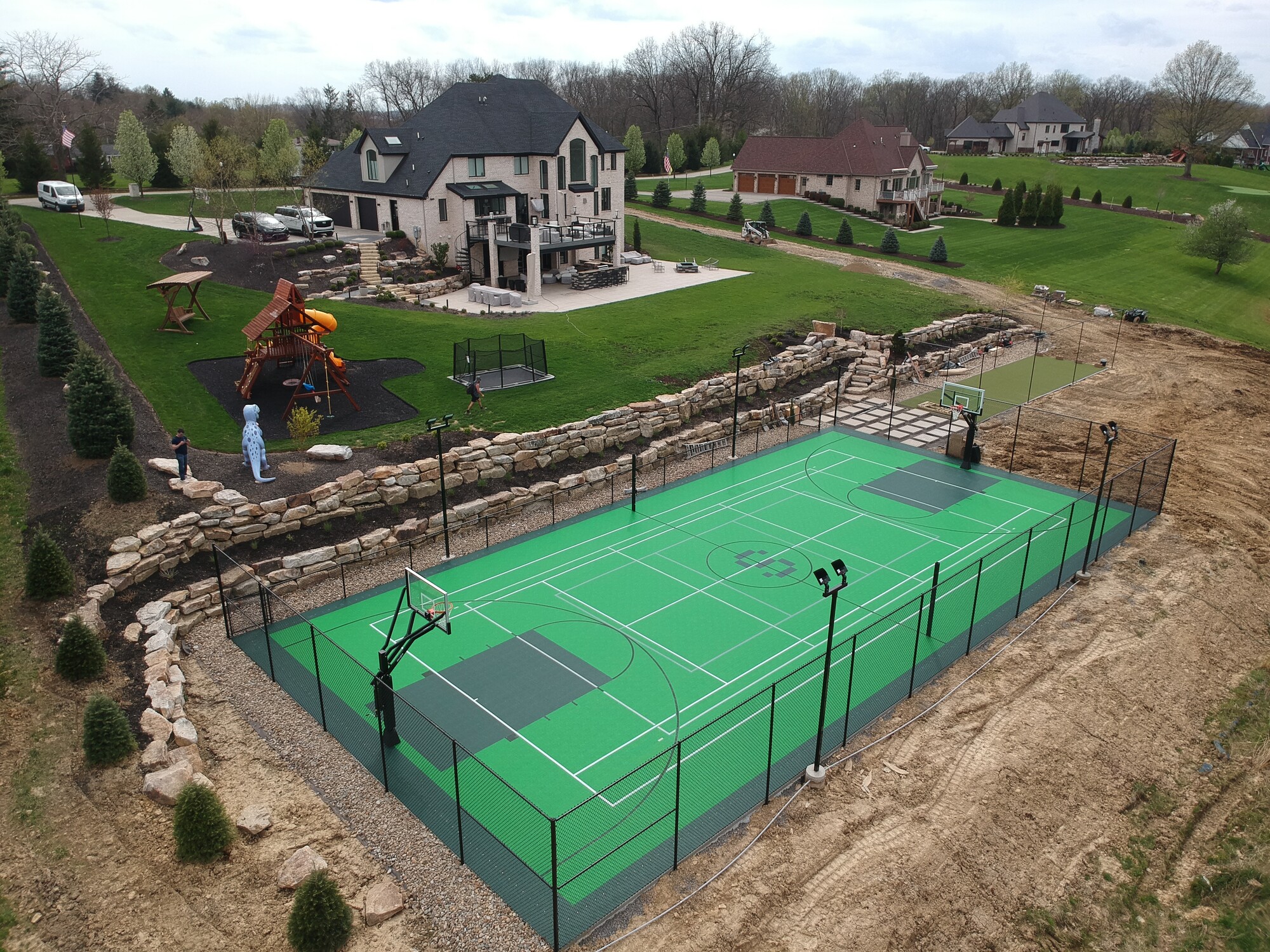
Transforming your outdoor basketball court into a dynamic hub for group fitness and fun begins with choosing the right surface. For decades, court builders were forced to settle for unforgiving concrete or asphalt pads that are limited in design options, take a heavy toll on growing joints and can wear down expensive gear quickly. By upgrading to a more premium surface, court builders can bring professional playability and added safety right to your court, whether it's in your backyard or at your fitness location of choice. With some surfaces even being designed for seamless DIY backyard basketball court flooring installation, the cost has never been more affordable, and a custom outdoor court has never been more achievable.
Why Upgrade to a Premium Outdoor Court Surface with Our Basketball Court Tiles?
For many court owners, the dream of an outdoor basketball court may begin with a basic portable hoop unit from your local sporting goods store placed at the edge of a patch of dirt or grass. Such a setup is perfect for casual shooting at an extremely low budget, but will quickly reveal significant limitations that can stunt athletic growth and overall player enjoyment. Playing on dirt or bare grass means dealing with unpredictable ball bounces that can ruin any hope of consistent gameplay, muddy shoes tracking into the house or your facility that waste time and effort to clean, and a surface that becomes completely unplayable after a light rain. A basketball court that has slick, wet grass in the playing area is a major injury waiting to happen. While a slight upgrade to bare concrete or asphalt can offer a more reliable ball bounce, it is still a punishing baseline for joints, often causing lower back fatigue, shin splints, and scraped knees during aggressive play.
Thankfully, there are a number of ways to completely transform the court recreation experience by prioritizing safety, higher performance, and accessibility.
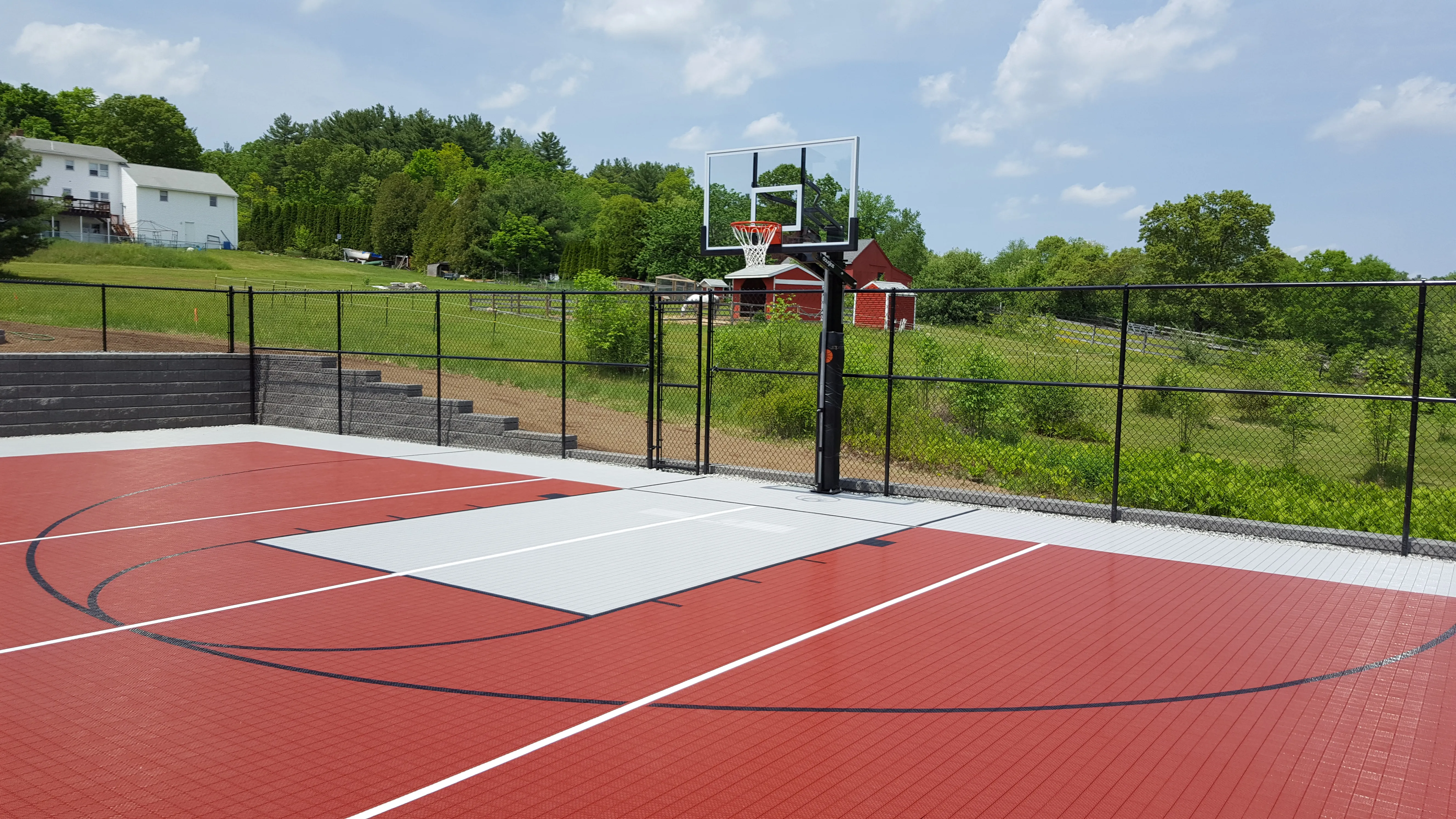
A combination Volleyball and Basketball Court in a Residential Backyard Space
What are The Most Popular Outdoor Basketball Court Surface Options Available?
There are several popular routes that any court builder can take when they are designing their outdoor basketball court space specifically.
Some of the more popular options aside from an open patch of earth can be seen below:
- Bare concrete or asphalt
- Poured polyurethane over asphalt/concrete base
- Acrylic coating over asphalt/concrete base
- Modular athletic tile
The options that are realistically considerable to the average basketball court owner will ultimately depend on several factors that will be unique to each situation. These factors include some of the obvious, such as the initial cost and budget of the project and the overall lifespan of the materials, but some additional considerations should be made as well to ensure you are making the wisest choice for your space. Deeper looks into the final cost of the project over the lifespan of the court, the maintenance (time and cost) involved with each type of surface, the installation or re-installation time involved, and the versatility of each type of material as well can change the outlook on the final decision. It is very important to think long term when planning your basketball court, the goal is to have a functional, enjoyable court space for a long, long time!
Initial Cost of an Outdoor Basketball Court vs. Total Lifespan Cost
When shopping for the best outdoor court surface for your space, the starting point for most researchers is usually the sticker cost of the materials involved. Many court owners make their decisions based on the initial cost of the project, a perfectly logical starting point for research on such a large purchase, but the more important factor to consider that can often be overlooked during research is the cost of the materials over the expected lifespan of the space.
In terms of initial cost, an option like modular tile may be a higher cost up front, but over the course of the 20+ years that a high-quality modular tile like HomeCourt by Mateflex is expected to be usable for, the total lifespan costs will even out and actually end up much lower than, say, an acrylic or polyurethane coating that will need to be re-applied every 1 - 3 years for the same lifespan of the tile option. It is incredibly important to consider all factors together to choose the best option for your space - the total expected maintenance costs of these materials should be considered along with the upfront sticker cost to give you the most accurate look at the total lifespan cost of your project.
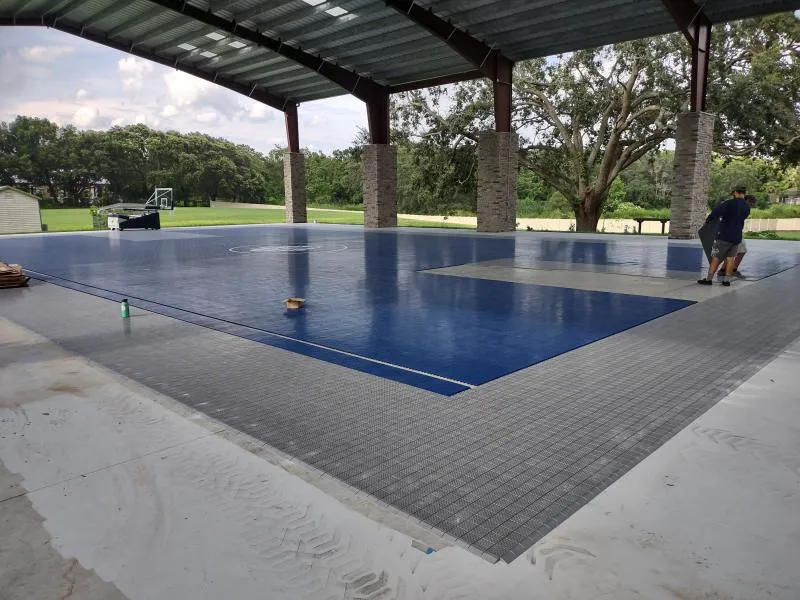
Installation of a Mateflex Basketball Court
Installation and Maintenance Time - Will This Affect Your Ability to Generate Results?
For many court owners, such as heath and fitness clubs, the ability to have consistent traffic and players renting court space may be a vital piece of business. With some court surface options requiring additional annual maintenance, whether this is patch and repair work, a re-application of a color or wear surface layer, or if there is significant leveling work that will need to be done to the underlying base, it is important to consider how this may affect your ability to either generate income for your business or to simply enjoy your backyard basketball court on a weekly basis. A court that can be quickly installed or repaired is extremely beneficial to those who are looking to minimize down time. This may come at a cost; whether there are additional steps and costs to be taken up-front to ensure your court is in ideal shape for a fresh urethane or acrylic coating, or if you will need to sacrifice some aesthetic flexibility to make sure that your court is accessible and modular to future-proof fixes surface damages or base repairs.
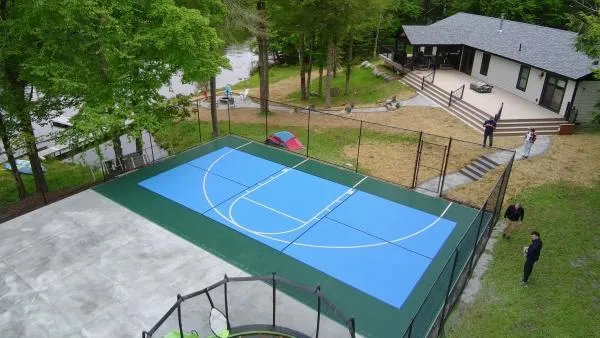
Many of our customers will include additional game lines to their Basketball courts. Pickleball lines are an easy addition to help maximize play time!
Surface Versatility
Are you interested in creating more than just a basketball court? Does the addition of an outdoor pickleball court, roller hockey rink, volleyball or tennis court sound like a necessity for your space? Certain surfaces are fantastic low-cost, low-maintenance options for specific applications, but would you want to dive for a volleyball over bare asphalt or concrete?
The flexibility to include additional game types can be an additional revenue driver for your health club or a fun addition to your backyard athletic court, and can also help minimize costs on the need for multiple courts. Creating a list of sports you may wish to include on your court footprint in order of priority will help to narrow down which surface styles may work best for you, although sometimes there may be a conflict of interest where the perfect option is very hard to find. For instance, many basketball court owners interested in a volleyball court surface may ALSO be interested in pickleball court flooring on the same layout. While this is achievable, it's important to consider which sports may take priority in this space. Volleyball court flooring tends to favor a softer, more cushioned surface with either a rubber underlayment or sandy base to accommodate diving and sliding players, while pickleball court surfaces will need to be made of a harder material that will provide a sturdy, solid ball bounce for the incredibly light pickleball. It can be difficult to accommodate multiple conflicting surface requirements in the same footprint, but recognizing this as a factor can help to prioritize which game type is more important for your space.
Quick Glance - Outdoor Basketball Court Surface Comparison Chart
Below is a quick glance at a comparison chart between some of the options that were previously discussed:
| Bare Concrete/Asphalt | Modular Tile | Acrylic Coating | Poured Polyurethane | |
| Initial Cost | Medium | Medium/High (Requires existing concrete/asphalt/pervious base) | Low/Medium (Requires existing concrete/asphalt base) | Medium/High (Requires existing concrete base) |
| Total Lifespan Cost (Relative to Each Option) | Low/Medium (frequent aesthetic fixes can quickly increase lifespan cost) | Low, requires very little annual maintenance aside from keeping the surface clear from debris. Repairs to tiles are very easy, low-cost, and can be done by the facility owner in a short time. Underlying aesthetic cracks are hidden by tile. | High, requires re-application and immediate fixes to prevent further damage | Very High, requires re-application and immediate fixes to prevent further damage |
| Install Time | Medium (based on court size, cure time can take a few days) | Fast, tiles are installed very quickly and paint cure time is ~3-5 days after | Medium/Fast, will take several days to apply and cure | Medium, will take several days to apply and cure |
| Lifespan of Product | Long, will heave/shift/crack over time | Very long, courts can last 20+ years | Very short, will need to be re-applied every 1-3 years to keep up appearance | Very short, will need to be re-applied every 1-3 years to keep up appearance and performance |
| Maintenance Level | Keep clear of debris and re-apply game lines as needed, hairline cracks may bother some customers and require frequent patches, otherwise this will depend on customer preference and budget | Very low, limited to keeping the surface clear of debris and touching up painted game lines as needed. Tile replacements can be done as needed by anybody | High, will require professional assistance to re-apply every 1-3 years and/or fix any base issues | Very high, will require professional assistance to patch or fix any base issues, will require a very high-quality base for peak performance |
| Versatility | Great for hard court needs, will be very hard on joints and knees or skin when diving or is necessary | High, can accommodate many applications and catered to customer needs, features lateral forgiveness that is easier on joints but provides a "hard" surface feel | Medium - is essentially the same playability as a hard surface with no added cushion | Medium - can be cushioned as needed, may affect courts that will require a harder surface like pickleball |
| Weather Drainage/Return to Playability | Poor, relies on slope and maintaining a flat surface with no dips or "bird baths" | Excellent, water will drain through tile and off the side of the existing pad underneath the surface | Poor, relies on pad slope and maintaining a flat surface with no dips or "bird baths" | Good, typically porous |
| Ideal Customer | Homeowners with low budget or needs, especially if this is a common space shared with a driveway or patio | Anyone with an existing pad or the budget to pour a new pad, courts are extremely long lasting with minimal maintenance and are the ideal choice for court owners with a 20+ year timeframe for their space | High-end facilities with a large annual budget, will give the most professional look and feel with the highest lifespan cost | High-end facilities with large budget |
Conclusion
Building the ultimate outdoor basketball court is ultimately a journey that should be a fun and personalized experience. There is no "right" or "wrong" answer, but there is definitely an answer that is the most optimized for your specific situation. The chart above is intended to help bring context to each option, but each project is completely different, the choice will ultimately be up to you to find the surface that will work best within your means. While a high-end facility will certainly look the best with a consistent acrylic or polyurethane coated surface done by a professional, the average homeowner looking for a DIY backyard basketball court surface for their family will ultimately best be served by a product that they can handle working with on their own.
For more information on the best modular tile court surface for your outdoor basketball court, consider visiting our HomeCourt tile surface page. Interested in building a DIY backyard basketball court or a new surface for your basketball court facility? Contact a Mateflex sales rep today for an in-depth quote!
Courtside Frequently Asked Questions
Below are some frequently asked questions regarding the construction of outdoor basketball court surfaces:
Yes! Many customers choose to do these projects on their own. If you already have a concrete or asphalt pad in place and are looking to spruce it up by overlaying our tile system, DIY is the way to go. Or, you can hire your trusted local contractor to build the base for the court and install the tiles to keep your costs down.
Game lines are masked out using quality tapes then treated with specialized primers and an application of a high-performance, specialized 2-part polyurethane paint.
Small DIY courts can be painted in-house in our controlled paint room setting, but larger court layouts are typically painted on site.
There are several sizes to consider when planning to construct an indoor or outdoor basketball court. Professional and other high-talent leagues such as the NBA and NCAA will use an in-bounds area of 94’ x 50’ for their basketball court dimensions, and international leagues such as FIBA will specify a very similar size of 28 meters (92’ ft.) by 15 meters (49’ ft.). High School basketball court regulations call for an 84’ x 50’ in-bounds area, and younger leagues can have an even smaller court dimensions, most commonly a size of approximately 74’ x 42’.
Note that for safety purposes, it is highly recommended to add an additional 3’ - 5’ of sideline and 6’ - 10’ of endline space beyond the painted perimeter lines for extra out of bounds area so that players are not stepping directly off of the surface as they go out of bounds, this can create a tripping hazard and be dangerous to players if not accounted for. Luckily, Mateflex can create a custom court layout to fit your exact needs, no matter what size basketball court you will require.
Q: How long is a volleyball court? (What are the dimensions of a regulation volleyball court)?
A: There are two main sets of indoor volleyball court dimensions that are commonly seen in school sanctioned, club and casual play, and one has seemingly replaced the other as the more “standard” size. Traditionally, the in-bounds area of a volleyball floor would measure 60’ x 30’ in total, however the most recent update to most volleyball court construction guidelines will now call for a more metric-based sizing of 18m x 9m, approximately 59’ long by 29’ 6” wide.
After including the required out of bounds space, the total footprint of the court space will measure 27m x 15m (4.5m beyond each end line and 3m beyond each sideline, approximately 89’ - 90’ x 50’) per NCAA regulations rule 1.1.1, or 24m x 15m (3m beyond each side, approximately 79’ x 50’) per the USA Volleyball specs. Note again that planning for the correct court dimensions with the out of bounds space included is extremely important, as the current rules can penalize teams for having the incorrect court dimensions.
The cost of a backyard basketball court varies based on a number of factors. Some variables to consider when estimating the cost are excavation to prepare the site, basketball floor size, outdoor basketball court tile choice, accessories such as basketball hoops, containment netting, and lights.
It varies based on site preparation, surface choice, and whether you're building from scratch or converting existing space. DIY installations with Matéflex can be completed at a fraction of the cost of traditional construction. Contact us for a custom quote tailored to your specific project.
When plastic is put out into the elements, it will expand and contract with varying temperatures and sun conditions. If this is not accommodated for in the design and installation of the modular tile surface, several issues can arise. The surface can shift over time, buckle in extreme heat, and cause inaccurate game line dimensions, just to name a few. Matéflex accounts for all of this with its unique expansion joint technology.
This technology is what sets our outdoor court flooring surfaces above the competition for all sports. The expansion joints allow the tiles to be flexible and conform better to uneven sub-surfaces, providing more consistent ball bounces than any other outdoor tile on the market.
The expansion joints also allow the court to be fastened to the subsurface around the perimeter of the court. This is done for several practical reasons, the first being to prevent physical or thermal movement of the surface throughout its long service life. When properly fastened, the tiles are designed to expand and contract within their own footprint, eliminating any concerns with thermal expansion. This allows the tiles to be trimmed tightly to any vertical obstruction, giving the court a very clean and finished look. It also ensures that your game line dimensions will be accurate regardless of temperature and sun conditions.
The expansion joint technology is one of many reasons Matéflex flooring surfaces are the perfect balance of performance and durability for your next outdoor sports court project.
Matéflex III and HomeCourt® are great outdoor basketball court tiles that cover existing court surfaces. Both have perforated designs to allow water to drain through the tiles, making the court dry quicker and getting you back on the court far sooner than traditional surfaces.
Matéflex III and HomeCourt® each have 21 different standard color options. Expansion joint technology allows them to conform to the subsurface and be permanently installed with no concerns about thermal expansion. Matéflex III is a long-standing, strong performer, and HomeCourt® is a more heavy-duty tile with smoother edges for extra safety. Either is an excellent choice for your custom basketball court design.
Our courts come with a 15-year warranty but the life expectancy is more than 20 years.
Contact us today for more information.
First, decide what size court you want and how much space you have available. A good starting point is a 30'x60' court, which gives you room for a full 3-point line on a half basketball court and room for many other popular applications like pickleball, shuffleboard, badminton, and more.
Next, contact Matéflex with your court dimensions. We may have a representative in your area who can help build your court from the ground up, or if you have a local contractor who can get your base installed, Matéflex can provide a fully painted DIY kit.
Either way, Matéflex can walk you through the process for the most cost-effective solution. We can also provide any basketball goals, lights, containment netting, and other court amenities for your project.